⭐ Houston's go-to place for DIY property-tax protest — no account needed
★ Free to check — no account needed
Is your home being over-taxed?
Free check in under a minute. We show you what you'd save — and you keep 100% of it. No login, just your address.
Your home address
+ add another home
Tap all that apply
☑ Main home
☐ 65 or older
☐ Disabled
☐ Veteran
What's your VA disability rating?
10% – 90%
100% / unemployability
No login, no password. Just your address.
$0FREE TO CHECKKit from $39
Often, yes — and it happens in two separate ways. HCAD appraises homes in bulk, so a home can be carried above near-identical neighbours; that is what a protest corrects. Separately, 328,310 of Harris County's 1,157,293 single-family homes have no homestead exemption on record — filing one is free and can be backdated up to two years. The free check above reads HCAD's own public roll and tells you which of the two applies to your address.
$0
To check your home
$39
Do-it-yourself protest kit
3
Steps — no account needed
How it works
How it works
Everything about lowering your bill — protest, exemptions, and what's in the kit — in three quick tabs.
How a protest works when your home is over-valued
Your tax is your home's value × the tax rate. Every year HCAD sets that value — and often too high vs. similar homes. You pay tax on the whole number, so an inflated value means a bigger bill. A protest tells HCAD "similar homes are valued lower — mine should be too," backed by comparable homes as proof. If HCAD agrees, your value drops and your tax drops.
1. Check your home — free
Type your address, tick the boxes. We tell you if you're over-taxed and roughly how much.
↓
2. Get your $39 kit
Your protest form comes filled out with the comps evidence attached. Keep one copy, file one to HCAD.
↓
3. File your protest — by May 15
Online (iFile), by mail, or in person. We show you how, step by step.
↓
4. Open a free HCAD account (2 min — we'll show you)
This is how you track your protest and see and accept a settlement offer online — many cases end right here, no hearing.
↓
5. HCAD reviews → offers a settlement
If the offer lowers your value fairly, accept it in your HCAD account. Done — you keep 100% of the savings.
↓ don't like the amount, or they rejected your protest?
6. Your case goes to the ARB hearing
If the settlement is too low, or HCAD rejects your protest, you get a short, informal hearing with the Appraisal Review Board. You present the comps from your kit — by phone or online, so you don't have to go anywhere.
Our role: we don't attend or represent you — we're not a law firm. We give you the ready-made evidence and the script; you stay in control and keep every dollar.
↓
If you're denied — you still have options
Request binding arbitration within 60 days. For a homestead worth $500,000 or less the deposit is $450 — and you get all but $50 back if you win. Or just check again next year — the recheck is always free.
One more way to lower your bill — exemptions
A protest lowers your value. Exemptions are separate discounts (homestead, over-65, disability, veteran) — free to file, any time. Most people should do both.
Free discounts you may already qualify for
These lower your tax on top of any protest. We fill the forms free — you just sign and send.
🔑 Homestead exemptionSTART HERE
Qualify if: you own the home and it's your primary residence (not a rental or second home). Saves: $140,000 off your school-taxed value (+ county %). Bring: a TX driver's license matching the address.
Must be your primary residence — and you need homestead first before adding over-65, disability, or surviving-spouse.
✓ HCAD app✓ Mail✓ In person✓ Online form
Over-65
Qualify if: you (or a co-owner living there) are 65+. Saves: extra $60k + freezes school tax. Bring: your DL.
✓ Mail✓ In person✓ Online form
Disability
Qualify if: disabled under Social Security (SSDI). Saves: same $60k tier (pick this OR over-65). Bring: SSA letter or doctor's note.
✓ Mail✓ In person✓ Online form
Disabled veteran
Qualify if: VA rating 10%+. Bring: VA rating letter.
Partial (10–90%): $5k–$12k on any one home you own. 100%: fully exempt, primary residence only.
✓ Mail✓ In person✓ Online form
Surviving spouse
Qualify if: 55+ spouse of an over-65 owner, or spouse of a fallen/qualifying veteran. Bring: death certificate + not-remarried statement.
✓ Mail✓ In person✓ Online form
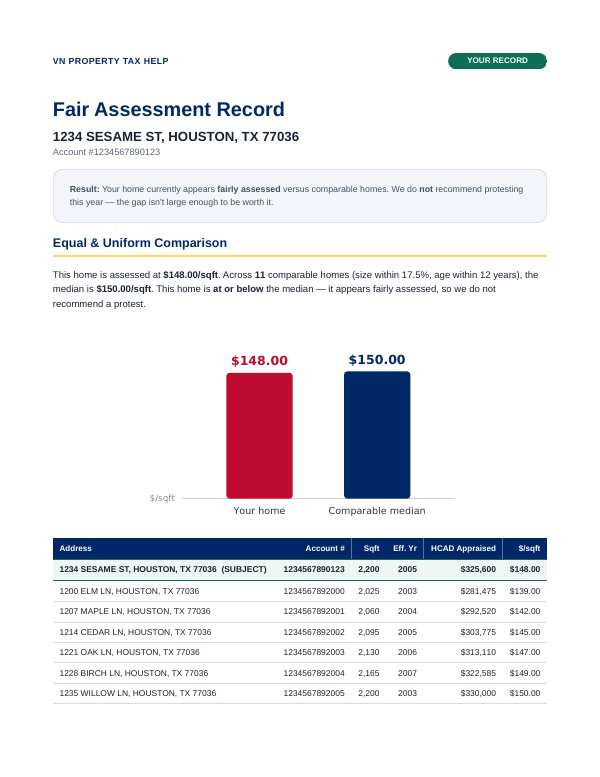
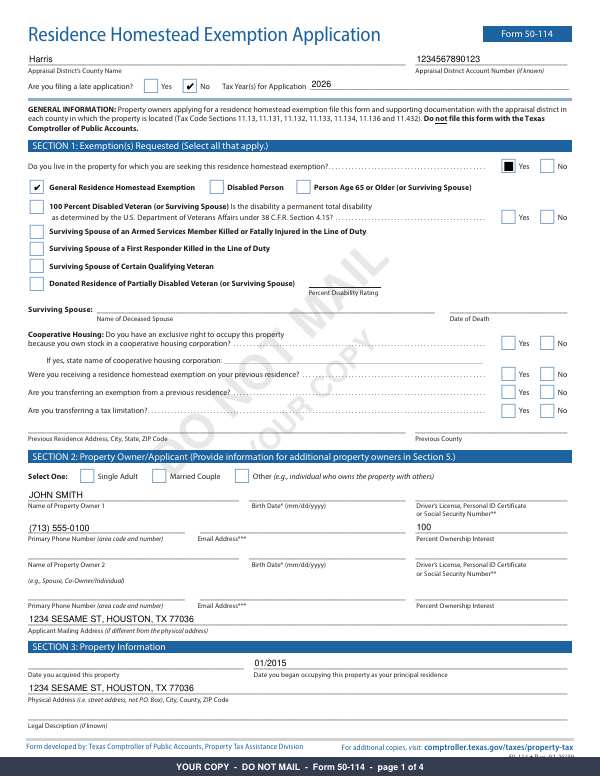
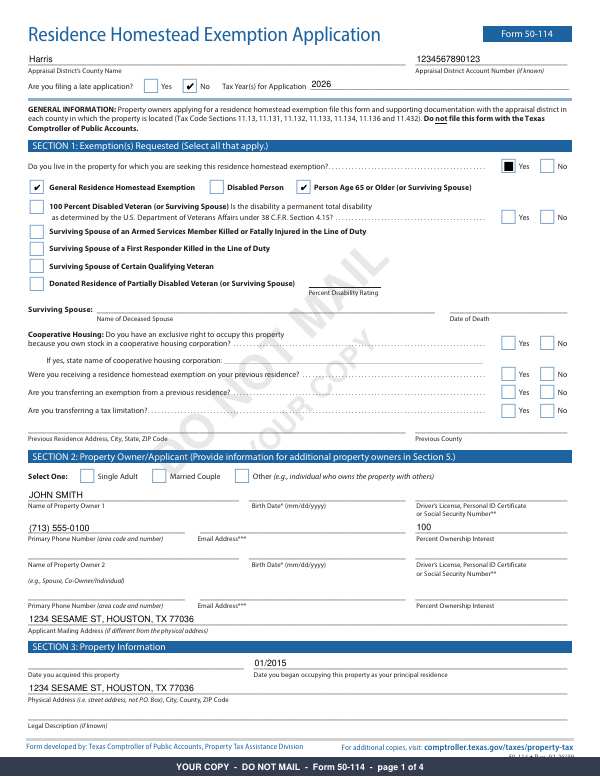
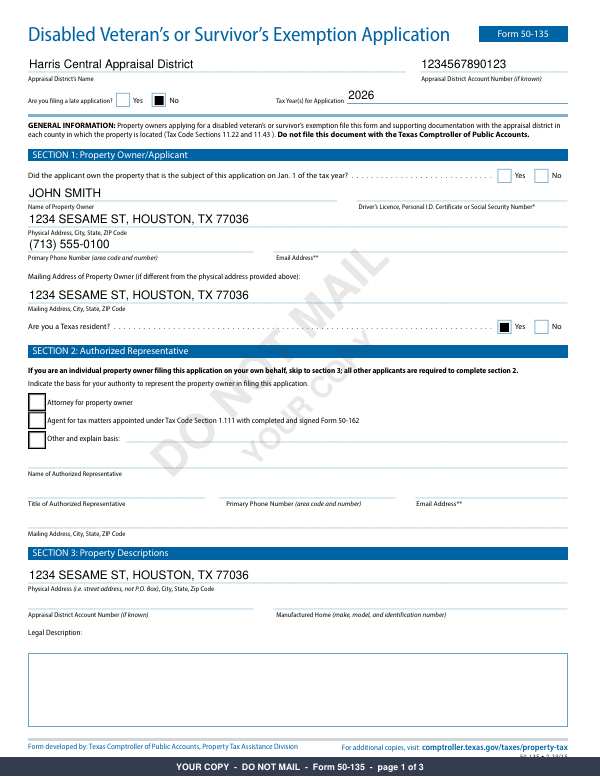
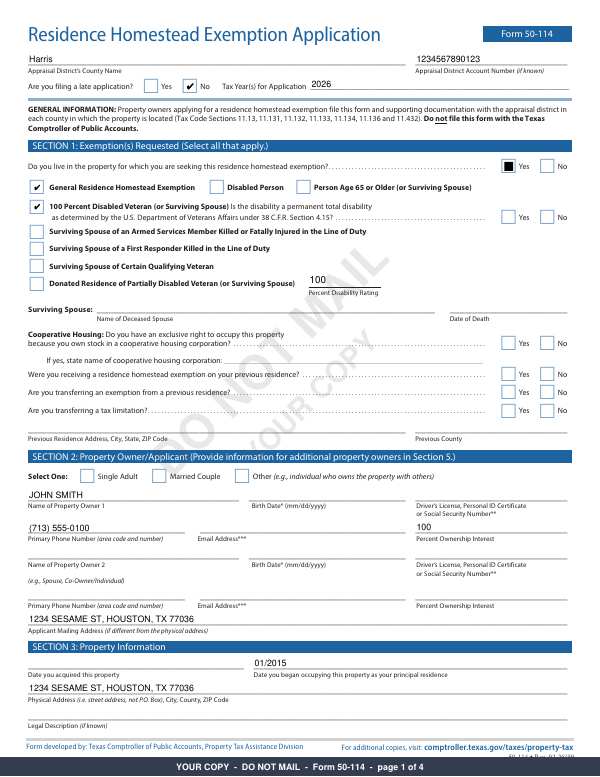
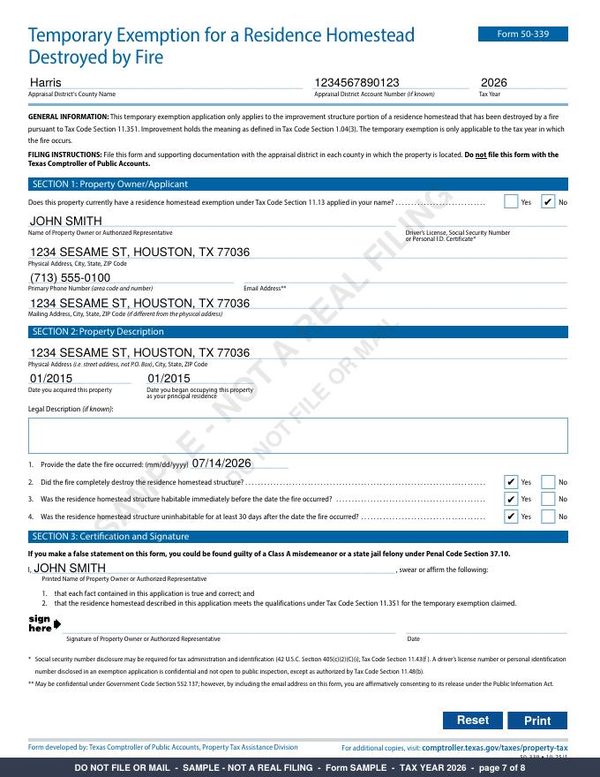
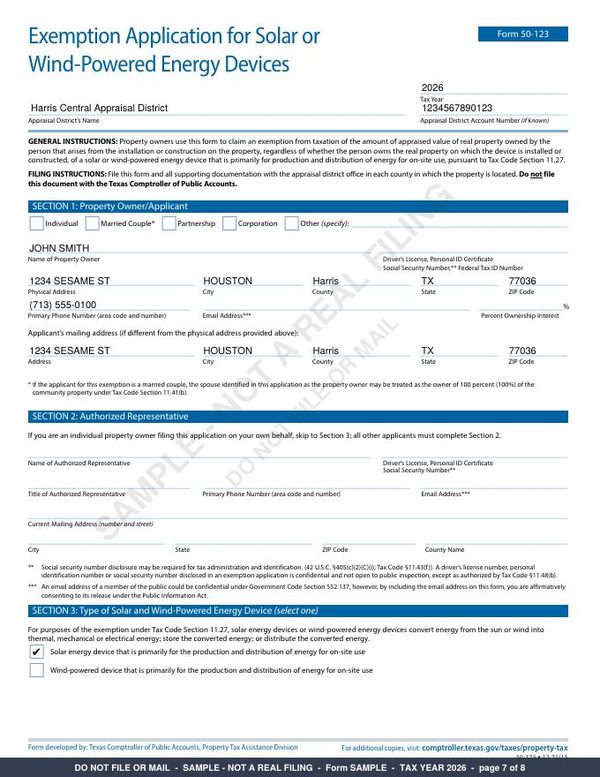
Want to see what a filled-out exemption form looks like? Take a look at real examples.
What's in your $39 kit
Everything you need to protest yourself — filled out and ready. You stay in control; we never take a cut.
📝
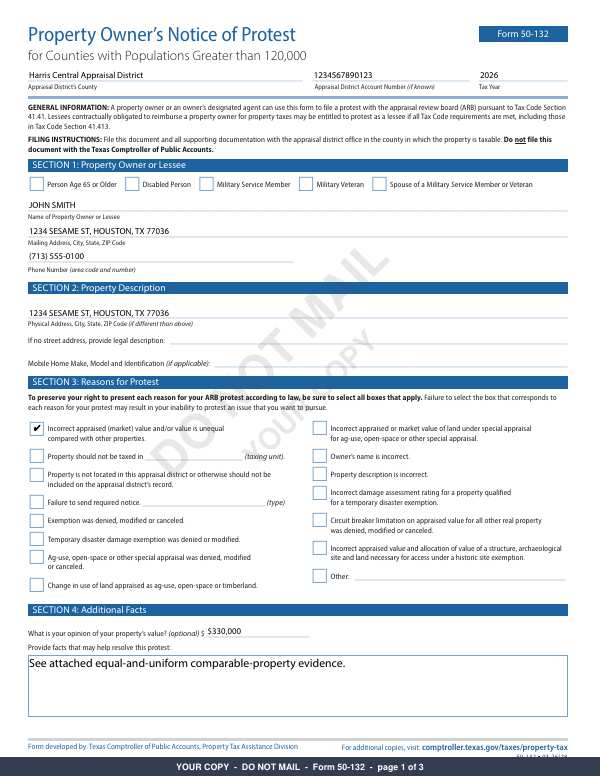
Your protest form — filled out
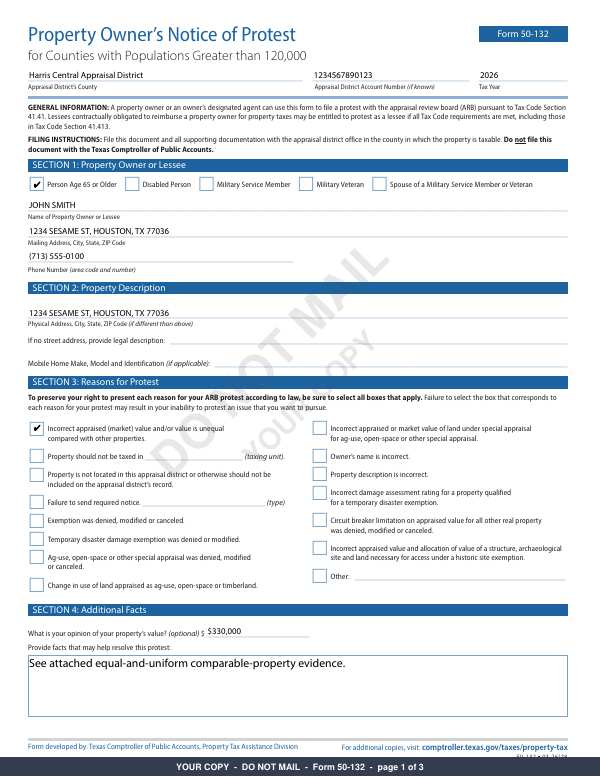
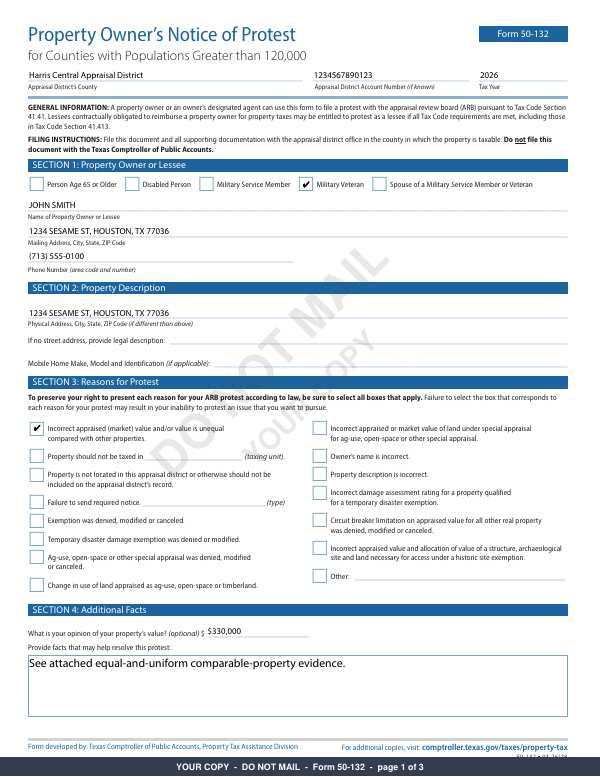
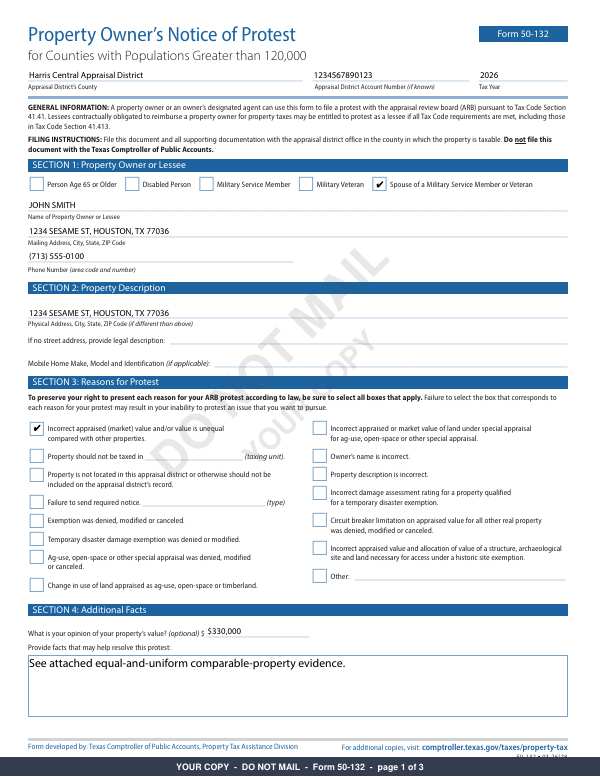
The official Form 50-132, completed with your property details. You just sign it.
📊
Your evidence — real comparable homes
Homes like yours from HCAD's own public records — the "equal and uniform" case they must consider. Not Zillow guesses.
📄
Two copies — keep one, file one
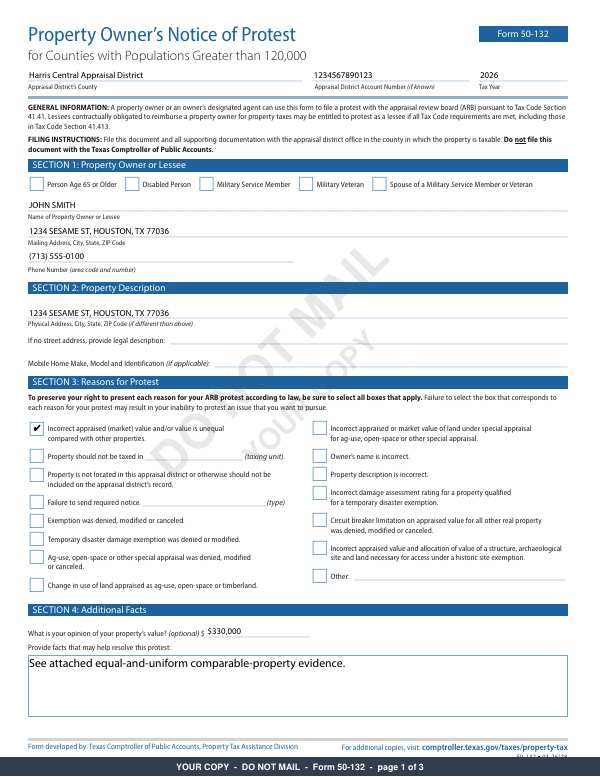
The copy you keep is watermarked "YOUR COPY / DO NOT MAIL" so you always know which is yours. The other is a clean copy to file to HCAD.
🎁
Your exemption forms — free
If you qualify (homestead, over-65, veteran…), we fill those out too — at no charge.
🧭
Step-by-step filing help
After you buy, a plain-language walkthrough shows you how to file online (iFile) — with a direct link to HCAD — or by mail or in person.
The kit is built for your home after a free check — so we know your numbers first.
Samples
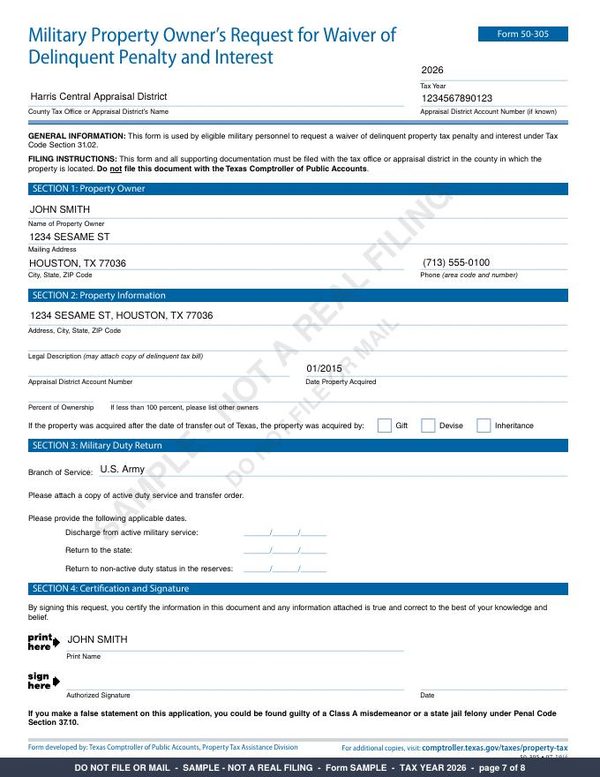
See real filled-out examples
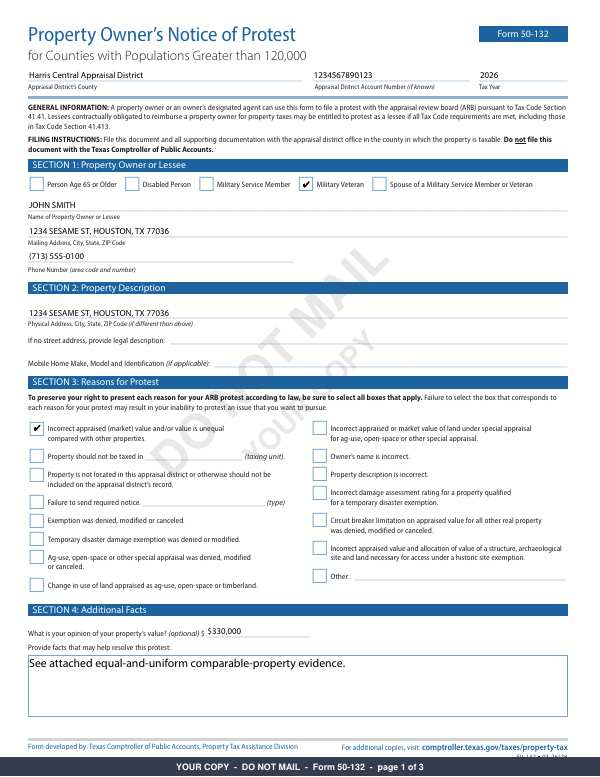
Real layout, fake info (John Smith · 1234 Sesame St). Tap a card to open the full PDF — just a preview, nothing gets filed.
The one to remember is May 15 — the protest deadline. Exemptions are relaxed; you can file almost any time.
JAN 1 – APR 30
File your exemptions
Homestead, over-65, veteran, etc. Relaxed — late filing is allowed (homestead up to ~2 years back, veteran up to 5).
LATE MAR – EARLY APR
HCAD mails your Notice of Appraised Value
This is your new value — the number you'd protest. Watch your mailbox.
MAY 15 — DON'T MISS THIS
Protest deadline
File your protest by May 15 — or within 30 days of your notice, whichever is later. Miss it and you wait a whole year.
MAY – JULY
Settlements & ARB hearings
HCAD reviews your protest, may offer a settlement online, and schedules hearings for the rest.
MID – LATE AUG
Values are certified (locked)
The roll is final for the year.
OCT → JAN 31
Tax bills mailed → payment due
Bills go out in October; payment is due by Jan 31 (late Feb 1).
Not protest season yet? No problem — check your home free now, and we'll remind you when it's time. Exemptions you can start today.
Get a free reminder before next season
We store your email and address only to send the reminder — nothing else.
✓ You're on the list — we'll email you before next protest season.
Questions
Common questions
Tap a question to open the answer.
Money & trust
Do you take a cut of my savings?
No. It's a flat $39, one time — you keep 100% of whatever you save. Full-service firms often take 25–50% — a range one of those firms (Ownwell) publishes on its own blog.
What's your refund policy?
The $39 kit is a digital product delivered instantly — it downloads when you pay, and your receipt email has a re-download link — so all sales are generally final. BUT if your kit fails to generate or you don't receive it, email us via the Contact link in the footer and we'll re-send it or refund you in full. Exemptions are always free. No outcome is guaranteed — HCAD decides.
Do you show up to the hearing for me?
No — we're not a law firm and don't represent you. We give you the filled-out forms, the evidence, and a simple script. You stay in control and keep every dollar.
Do you guarantee I'll win my protest?
No — we can't guarantee the outcome. The decision is HCAD's to make, not ours. What we do is hand you the strongest possible case: real comparable homes pulled from HCAD's own records, plus your forms filled out and ready. You walk in well-documented and prepared — but the outcome is always up to HCAD. The one thing we do guarantee is our own side of it: if you protest and HCAD doesn't bring your market value down by at least $2,000, next season's kit is free.
Why are your comps better than Zillow?
Texas doesn't make sale prices public, so Zillow's numbers aren't something HCAD has to accept. We use HCAD's own appraised values of similar homes — the evidence they're legally required to consider.
¿Por qué mi vecino paga menos que yo por la misma casa?
Por el tope del 10% de la vivienda principal (Tax Code §23.23), que es algo distinto de la exención de vivienda principal. Una vez que una casa tiene vivienda principal, su valor tasado sólo puede subir 10% al año por rápido que se mueva el mercado. Quien lleva años en su casa ha tenido ese freno todo el tiempo. Si usted compró hace poco, no tiene tope acumulado.
Misma casa, misma calle
Mercado
Tasado
Vecino, con años en la casa
$142,436
$116,588
Usted, compró el año pasado
$142,436
$142,436
Ésos son dos valores reales de una casa real del condado de Harris, y un vecino sin tope todavía. 163,495 casas de este condado — alrededor de una de cada siete — están hoy en esa situación. También significa que no debe armar una protesta comparándose con vecinos que sí tienen tope: el distrito la desmonta. Explicación completa aquí.
Filing & deadlines
How do I actually file my protest?
Three ways: online (iFile), by mail, or in person. After you get your kit we show you exactly how, with a direct link to HCAD.
What's the deadline?
May 15 — or within 30 days of your notice, whichever is later. Miss it and you wait a year.
What is "iFile"?
It's HCAD's online filing system. You log into HCAD's website and upload your protest instead of mailing it — usually the fastest way.
What if I'm denied?
You can request binding arbitration (for a homestead worth $500,000 or less the deposit is $450, and you get all but $50 back if you win), or just check again next year — the recheck is always free.
The hearing (ARB)
Getting started & exemptions
Is the check really free?
Yes — the address check is free, no login. You only pay $39 if you decide to buy a protest kit. Exemptions are always free.
Are the exemption forms really free?
Yes. We fill out homestead, over-65, veteran and other exemption forms at no charge — you just sign and send.
I own more than one home — can you help?
Yes. Add each home and we sort out which one is your homestead, then prepare a protest for each.
What languages is this in?
This site is in Vietnamese and English. The copy of your forms that you keep is in Vietnamese, so you understand exactly what you're filing — plus a clean English copy to file with HCAD (by iFile, mail, or in person), since HCAD reads English.This site is in Spanish and English. The copy of your forms that you keep is in Spanish, so you understand exactly what you're filing — plus a clean English copy to file with HCAD (by iFile, mail, or in person), since HCAD reads English.
Why us
Why us
Three ways to fight your taxes — and why we keep the savings in your pocket.
FULLY ON YOUR OWN
Do it yourself
$0 + your time
• You hunt for your own comps • You fill every form • Easy to miss exemptions • Weak evidence = weak case ✓ Keep 100% — but lots of work
BEST VALUE
You — with us
$39 one-time
✓ Real HCAD comps evidence ✓ Forms filled, ready to file ✓ Exemptions prepared free ✓ Keep 100% of savings ✓ You file — full control
THEY TAKE A CUT
Full-service firm
25–50% of savings
✓ They do it for you ✗ A big cut, every year ✗ Often auto-renews ✗ Less control ✗ Your savings, their pocket
Same evidence a firm would use — without giving away a slice of your savings every year. (The 25–50% range above is published by Ownwell, one of those firms.)
Complete guide
The complete guide to protesting your Harris County property taxes
Every year, the Harris Central Appraisal District (HCAD) sets a value on your home, and your property-tax bill is that value multiplied by your local tax rate. When HCAD sets your value too high compared with similar homes, you pay tax on money your home isn't worth. This guide explains, in plain English, how to check whether you're over-assessed and how to lower your bill — the same process a paid firm uses, but done yourself so you keep 100% of the savings.
What "over-assessed" means
Texas law says your home must be appraised at market value and "equally and uniformly" with comparable properties. If nearby homes of similar size, age, and condition are valued lower per square foot than yours, you have grounds to protest. Because Texas is a non-disclosure state, actual sale prices are not public record — which is why the strongest evidence isn't a Zillow estimate, but HCAD's own appraised values of comparable homes, the numbers the appraisal district is legally required to consider.
How to protest, step by step
First, check your home for free to see whether you're over-assessed and by roughly how much. If you have a case, file a Notice of Protest (Form 50-132) with HCAD by May 15, or within 30 days of the date on your appraisal notice, whichever is later. You can file online through HCAD's iFile system, by mail, or in person. Then open a free HCAD online account so you can track your protest and review — and accept — any settlement offer HCAD makes; many protests are resolved this way without a hearing. If no offer arrives or it's too low, your case goes to an informal Appraisal Review Board (ARB) hearing, where you present your comparable-homes evidence by phone or online.
Exemptions: free money most homeowners miss
Separate from a protest, exemptions are discounts on your taxable value. The homestead exemption removes $140,000 from your school-district value and requires the home to be your primary residence. Homeowners 65 or older, or those with a qualifying disability, receive an additional $60,000 and a school-tax freeze. Disabled veterans receive $5,000–$12,000 by rating, and a 100%-rated veteran's homestead is fully exempt. Surviving spouses may inherit certain exemptions. Several exemptions can now be filed online with HCAD — the homestead application (which also carries the over-65 and disability boxes) through HCAD's online form or mobile app, and the disabled-veteran form too. Mail and in-person filing always work as well.
If you're denied
If the ARB's decision still leaves you over-assessed, you can request binding arbitration within 60 days. For a homestead worth $500,000 or less, the deposit is $450, and the state refunds all but $50 if you win. Otherwise, you can simply check again next year — values change, and the recheck is always free.
Ready to see where you stand?
Your forms
(IU counts the same as a 100% rating in Texas — if this is your main home, your entire homestead may be exempt under §11.131)
Finish your form now— optional
Fill these in and your PDF prints ready to upload to iFile. Prefer to write by hand? Leave any of them blank — we print a blank line so you can fill it in, then upload the scan. Nothing here is stored — no account is created.
No driver's license? A Texas ID card works too — just make sure the address on it matches your home. We don't ask for your Social Security number online; the form leaves a blank line for it, so you can hand-write it and upload the scan.
If your protest goes to a hearing— we recommend these; change any
HCAD's form asks how you'd handle a hearing. We pre-pick the answers most people want — you can change any of them on the printout.
In person, phone, and video all let you argue your case live — you keep the same rights. Phone, video, and written require sending your evidence to HCAD before the hearing; your kit includes exactly what to send and how.
Did you buy this home in the last 3 years?— optional, and the strongest evidence there is
Texas doesn't make sale prices public, so HCAD often doesn't know what you actually paid. If you bought recently and paid less than HCAD's value, what you paid is the strongest market-value evidence there is — not an estimate, not a computer model, but what a real buyer paid for this exact house. You already have the paperwork: the settlement statement from your closing.
Your settlement statement stays with you — we never collect it. You hand it straight to HCAD, same as your photos and repair estimates. The three answers below pass through to draw your PDF and are then discarded.
Anything else the law may owe you?— optional, and all free to apply for
These three are real, they are in the Tax Code, and almost nobody is told about them. None of them changes your protest — we add a page to your kit naming the right form and the deadline. Skip any that do not apply.
This is question 3 on the form. It is there to rule out a house that nobody could live in already — a burnt-out shell, a condemned building. If someone was living there the day before, the answer is Yes.
The deadline is 180 days from the fire itself — not from a tax bill, and not April 30.
You have 60 days from that date. Missing it does not take the relief away — it caps what you owe at 6% a year with no penalty, instead of 12% plus 1% a month.
Does the home have problems?— optional, strong extra evidence
Bad roof, foundation cracks, flood damage, broken A/C… HCAD values your home as if it's in average condition. A documented problem — best proven by a written repair estimate — means it's worth less. List what you have and we do the math on your protest form, plus print a cover sheet that organizes it all.
Your photos and papers stay with you — we never collect them. You give them straight to HCAD: filing online (iFile) → upload each photo/estimate when iFile asks for evidence. Filing by mail or in person → print them and stack them behind the cover sheet in your kit, same envelope as the form. Your kit repeats these exact steps.
⚠️ Check this name — it is your signature on a sworn form. It must match your photo ID (driver's license), written the normal way. We copied the name from step 1; fix it here if that's not how your ID reads.
By typing your name you're signing this sworn form. Prefer to sign by hand? Leave it blank — we'll leave a signature line on the printed form.
Your answers — change any before you file.
These are the choices you made; we just place them on the form.
Areas we cover
Find the numbers for your part of Harris County
Click your area below to see specific information for where you live.